DELTA 3-ALPHA Delta 3-Alpha Contact
Officers standing around a lit map table in a field command post at night, seen in silhouette Delta 3-Alpha, Mission Decision Layer

Delta 3-Alpha · Concept study · Dual-use · Munich

DELTA 3-ALPHAReducing Δ from sensor to decision

  1. We turn a flood of sensor reports into one framed problem.
  2. The commander decides once, with intent, on the record.
  3. Then every option opens up, and narrows to one order.
Manual first, AI optional Works when reachback does not A method, not another platform
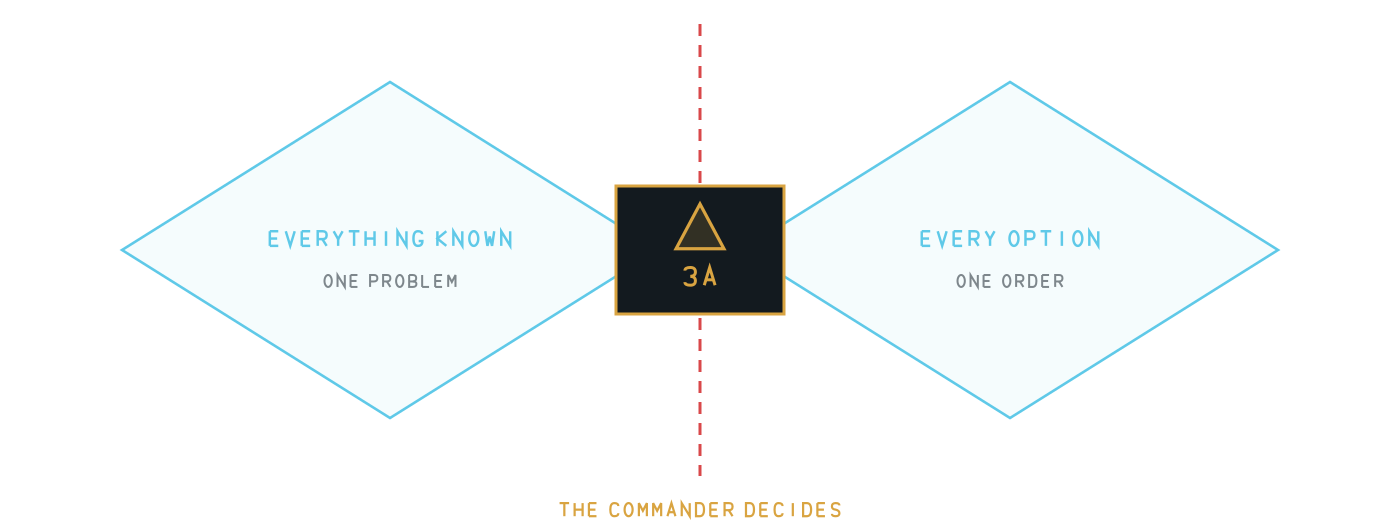
Two large diamonds with a marked decision point between them. Everything known goes into the first, the commander decides in the middle, options open again in the second and narrow to one order.
  1. 01

    Widen, then frame

    Everything known, unknown and possible goes in. Nothing is filtered early. Out comes one stated problem.

  2. 02

    The commander decides

    Intent, effect sought, risk accepted. One person, one moment — captured with its basis and its time.

  3. 03

    Widen, then order

    Options generated freely, not just the first workable one. Then converge on the one that is executed.

01 The problem

Everyone is buying sensors and effectors. The delay sits between them.

Units and staffs today see either too little or far too much, but rarely the right thing at the right time. Four conditions produce that, and none of them is a shortage of data.

  1. 01

    The bottleneck moved and the spending did not

    More sensors, more platforms and more information meet the demand for faster decisions. Sensor coverage, drone feeds and effector inventories have all grown faster than the human capacity to turn them into a decision. What is scarce is not detection. It is a framed problem, a set of real options and an authorised choice, produced fast enough to matter.

  2. 02

    Design is in the doctrine in word only

    NATO leadership documents call for critical and creative thinking, and design is the discipline that delivers it. Yet doctrinal support for design remains limited and arguably declining: the few doctrines that mention it largely name the notion without setting out how to work with it. The method is endorsed and unpractised.

  3. 03

    The large programmes are buying the data layer

    Anduril was awarded the US Army's Next Generation Command and Control effort in 2026 and, with Palantir, supplies the edge-to-cloud data mesh beneath it; Lattice has been selected for NATO air command and control. These are formidable pipes. None of them tells a commander how to frame a problem or when the decision is his to make.

  4. 04

    When the link goes, the method has to remain

    Every one of those architectures assumes connectivity to something larger. In a contested environment, with denied, disrupted, intermittent and limited (DDIL) communications, the platoon commander still has to decide. A decision architecture that only works with reachback is not a decision architecture. It is a subscription.

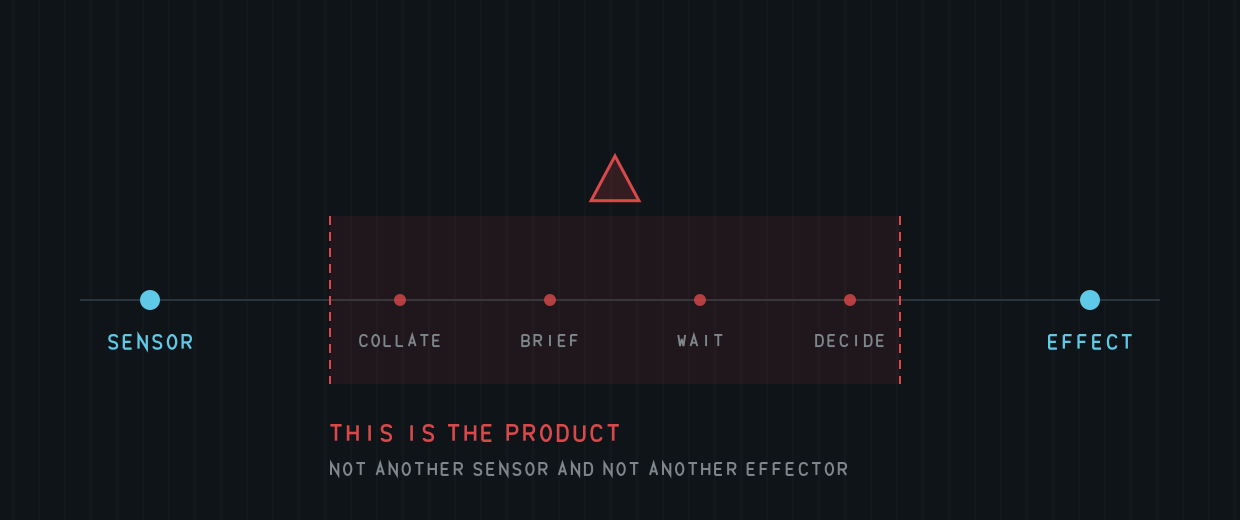
A timeline from a sensor report to an executed effect. The gap in the middle, marked delta, is where the time is lost: collating, briefing, waiting, deciding.
The delta Δ is the whole product. Not another sensor, not another effector — the interval between them, which is where operations are actually lost and which no procurement line currently owns.

Sources: Military Design in European Defence Forces; AJP-5, Allied Joint Doctrine for the Planning of Operations; Breaking Defense on Next Generation C2; NATO selects Lattice for air command and control.

02 The method

Two diamonds and one waist that does not move

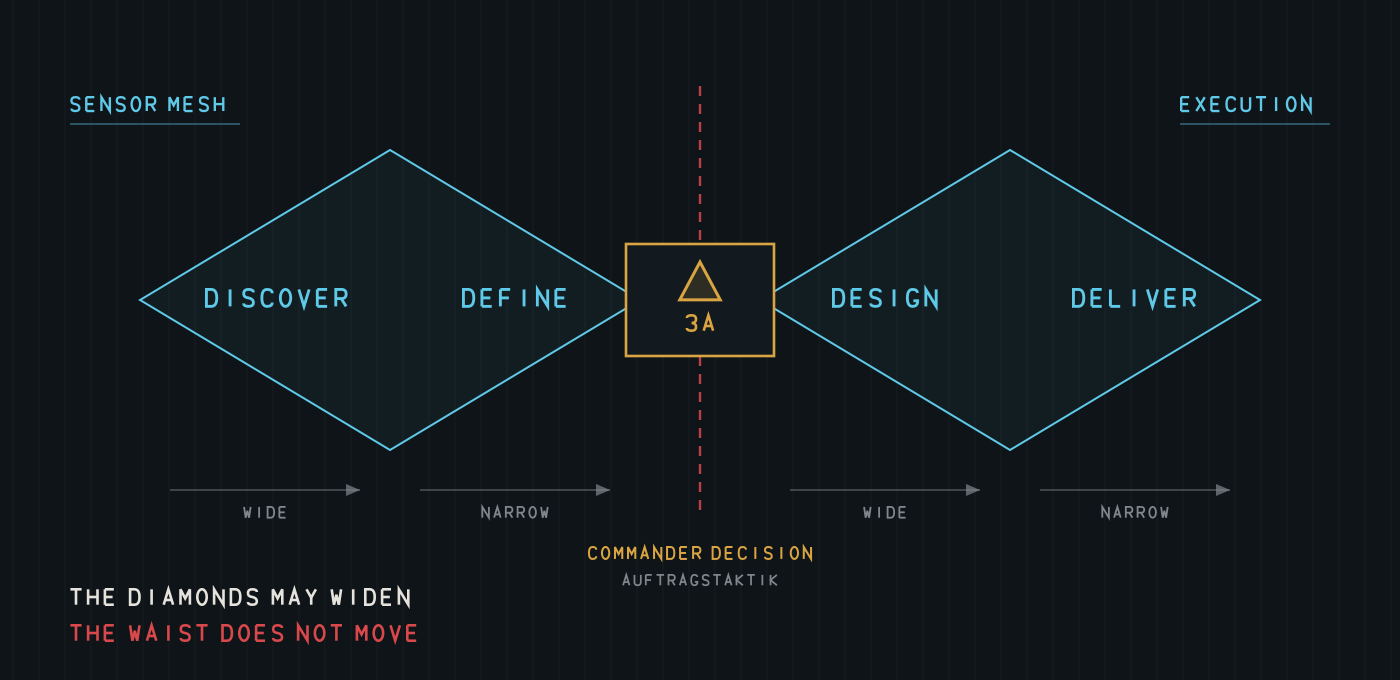
The double diamond is borrowed from design and adapted to command. Its value here is not the shape. It is that the shape has a fixed point in the middle, and that point is a person.

The left diamond opens wide to gather situation, problems and constraints, then narrows to a defined problem. At the waist sits the commander's decision, marked 3 Alpha. The right diamond opens wide again for options and narrows to one executed solution.
The architecture Left: open wide — everything that is known, unknown, broken and possible goes in, without early filtering. Then narrow to a stated problem. Waist: the commander decides, with intent, against the mission. Right: open wide again — options generated freely, without deference to the first idea — then converge on the one that will be executed.

A · The diamonds

Divergence is a discipline, not a luxury

Staffs under time pressure collapse to the first workable answer. Both diamonds exist to force the opposite: a deliberate widening before each narrowing, once for the problem and once for the solution. This is where machine support earns its place — not by choosing, but by widening faster than a human team can.

  • Discover and Define before the problem is fixed
  • Design and Deliver before the option is chosen
  • Every narrowing records what was discarded and why

B · The waist

3α is a person, not a function

Between the diamonds sits the commander's decision — intent, effect sought, acceptable risk. In German staff practice this is Auftragstaktik: the commander states what and why, and leaves the how to those executing. The system produces the material for that moment and records the moment itself.

  • Intent stated before options are chosen, not after
  • The decision, its basis and its time are recorded
  • Subordinates receive the why, not only the what

03 Fit with doctrine

Nothing that already works is replaced

The fastest way to be rejected by a staff is to arrive with a new process. This is not one. It is a front end to the processes a staff is already trained, certified and inspected on. It feeds the command and control (C2) systems a unit already runs and travels over whatever bearer the unit's PACE plan (primary, alternate, contingency, emergency) leaves — down to paper and voice.

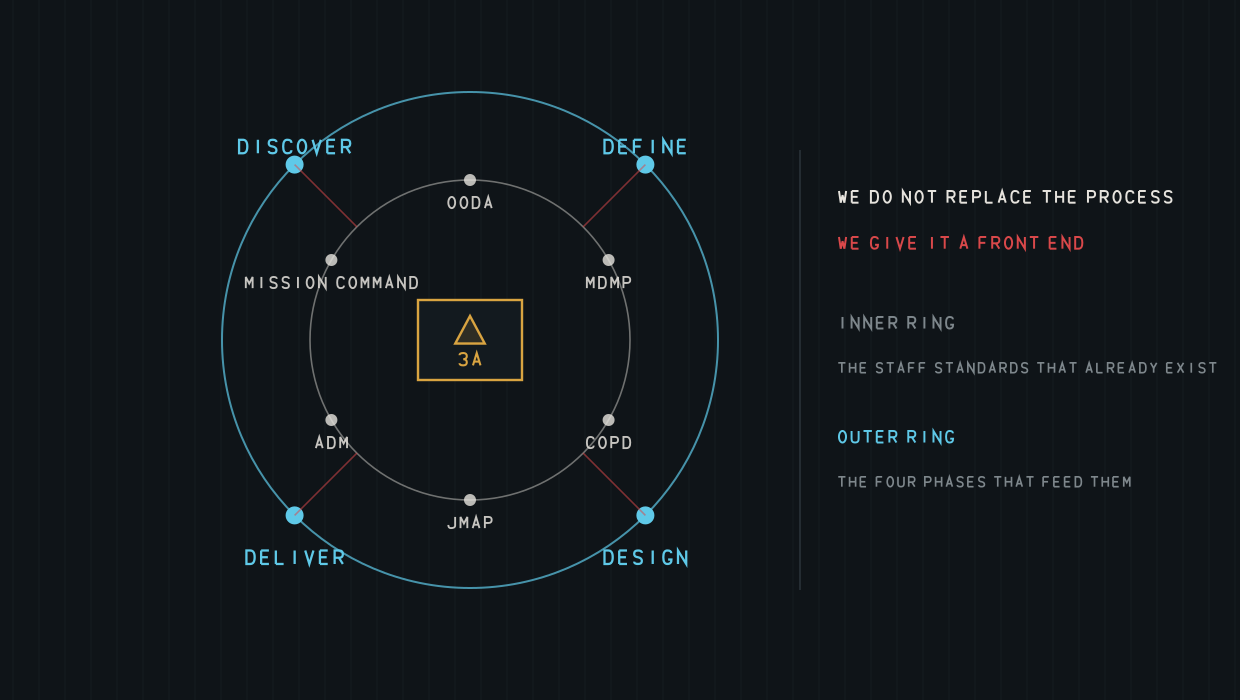
An inner ring carries the established staff processes OODA, MDMP, COPD, JMAP, ADM and Mission Command. An outer ring carries the four design phases, whose output flows inward.
Inner ring, outer ring OODA governs tempo, MDMP and COPD govern staff procedure, JMAP and ADM govern planning, Mission Command governs how orders are given. All of them assume a framed problem and a decided intent as their input. That input is exactly what the outer ring produces — which is why this can be adopted without a doctrinal change, and why it does not compete with the systems a staff already runs.

04 Across echelons

The same logic from a section leader to a brigade staff

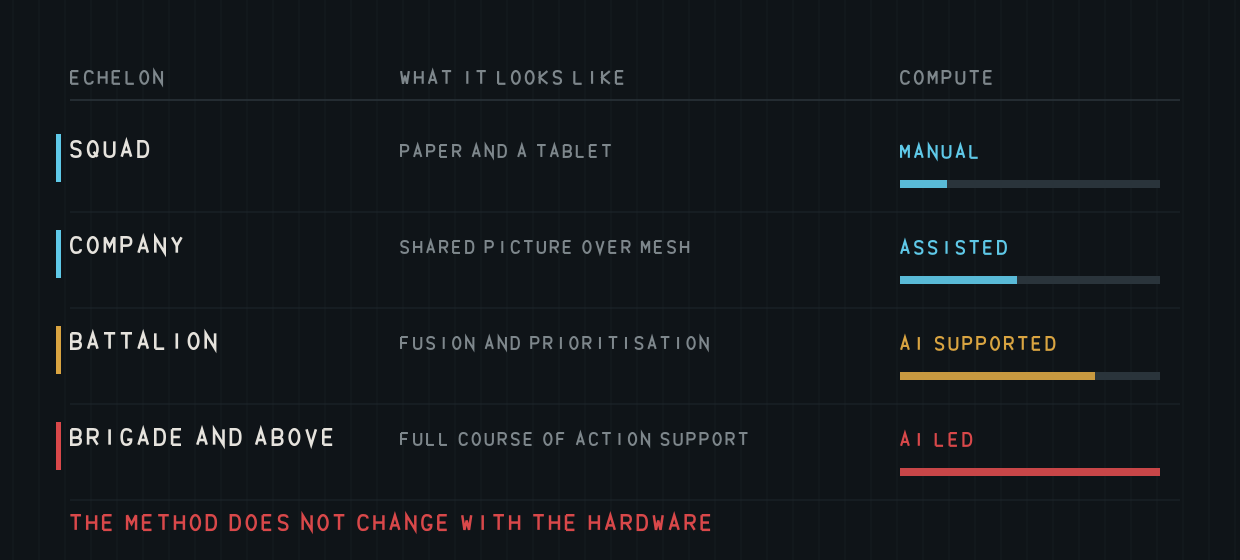
Most decision-support products are built for one echelon and one infrastructure. Here the method is the constant and the compute is the variable.

Four rows from squad to brigade. The same four phases and the same waist apply at every level; only the amount of compute changes, from a paper checklist to full course-of-action support.
Manual first, AI optional At squad level this is a laminated card and a tablet that works offline. At brigade level it is fusion, prioritisation and course-of-action support over a mesh. The system has to be useful with no AI at all — otherwise it fails on the day the compute, the link or the trust is not there, which is the day it is needed.

05 Market environment

A large market being spent on pipes, not on judgement

All figures are published third-party estimates. The spread between publishers here is unusually wide and is shown rather than reconciled.

Why now: capital is moving

USD 7.4 bn

European defence tech venture funding in 2026 to early October, projected USD 10.5 bn for the full year (2025: USD 2.6 bn)

Dealroom × Resilience Media, Oct 2026

USD 3.5 bn

raised by defence start-ups in Germany in 2026, more than any other European country

Dealroom × Resilience Media, Oct 2026

11.1 %

of all European venture funding went to defence in 2026, up from 4 % in 2025

Dealroom × Resilience Media, Oct 2026

Source: Dealroom × Resilience Media, The State of Defence Tech 2026 (5 October 2026), via Resilience Media. 2026 figures to early October.

12.5 – 19.6

USD bn · battlefield management systems, 2026

Publisher spread of roughly 1.6×

15.4 – 25.9

USD bn · same market by 2030 to 2031

CAGR estimates from 4.3 % to 7.3 %

≈ 34 %

share of that market held by command and control

Grand View Research

20

USD bn · Anduril's US Army Next Generation C2 award, March 2026

Ten-year term, with Palantir on the data layer

536

EUR m · reported German strike-drone orders to Helsing and Stark, Feb 2026

Inside a EUR 4.3 bn framework

0

documented products selling the decision method rather than the platform

Own assessment — see the caveat in section 07

Battlefield management systems: two publishers, 2026 to 2030

Published endpoints only. The gap between the two series is the honest measure of how firm these numbers are.

Sources: Research and Markets, Mordor Intelligence, Grand View Research.

Where this sits in the money

The incumbents are not competitors in the ordinary sense. Anduril's Lattice and Palantir's platform are the substrate: data movement, fusion, an enterprise picture. Helsing has moved decisively toward effectors. A method that produces framed problems and recorded decisions is not an alternative to any of them — it is a layer they do not build, because it is a doctrine product rather than a data product.

The buyer is unusual, and that cuts both ways. The customer for a method is a training command, a staff college, an exercise directorate — not a procurement office buying seats. That means smaller initial contracts, slower cycles and no headline award. It also means an entry that does not require displacing an incumbent, and a position inside the way officers are taught to think, which is the most durable place in this industry to stand.

And the honest risk. Methods are hard to protect. A double diamond can be redrawn by anyone. What can be defended is the accumulated record — decisions, their basis, the options discarded and what actually happened — built up across exercises and operations. That is the same pattern as the signature corpus in the sister venture: the artefact is copyable, the accumulated record is not.

06 Doctrine and accountability

Why the waist has to be structural

Command responsibility is personal and cannot be delegated to a system. Any architecture that blurs where the decision was taken creates a liability no operational advantage compensates for.

Doctrinal and legal anchors, and their consequence for the design
AnchorWhat it saysConsequence for the design
AJP-5
Allied joint planning doctrine
Design, planning and execution are human matters in which commanders lead and staffs support; intuition, experience and military judgement remain paramount. The waist is doctrinally required, not a stylistic choice. The product supports the staff and records the commander — never the reverse.
NATO COPD
and the design gap
COPD provides the common framework for collaborative operational planning. Design is named in doctrine but largely unelaborated, and doctrinal support for it is limited. An accepted requirement with no accepted practice attached. That is the entry: supply the practice, in the vocabulary of the existing framework.
Mission Command
Auftragstaktik
Subordinates are given intent and freedom of method, which presupposes that intent has actually been formulated and transmitted. Intent is a required field, produced at the waist before options are selected. A plan without a recorded intent cannot leave the system.
EU AI Act (EU) 2024/1689
Art. 2(3) and Art. 14
Systems placed on the market exclusively for military or defence purposes are exempt. Outside that exemption, high-risk systems require human oversight and explicit awareness of automation bias. Two separately marketed lines from the outset, and automation bias treated as a design problem in both. Where AI decision support has been studied with operators, a substantial share admit the risk of overtrusting machine suggestions under time pressure.
Command responsibility
international humanitarian law
Responsibility for an order attaches to the commander who gave it, and must be reconstructable after the fact. The record is not a feature for auditors, it is protection for the commander. What was known, what was discarded, what was intended and when — captured as a by-product of using the method rather than as extra work.

Primary sources: AJP-5 Ed. B, NATO COPD, Regulation (EU) 2024/1689.

07 White space

The pipes are taken. The judgement is not.

Finding from doctrinal literature, published programme awards and vendor material. This is the least proven of the four positions in this family and is stated as a hypothesis.

  1. A

    Design is doctrine in name only

    The requirement for critical and creative thinking is stated at the highest level. The practice is not written down, not taught systematically and not tooled. An accepted need with no accepted method is the rarest kind of opening, and it is open now.

  2. B

    Nothing scales from a paper card to a staff cell on one logic

    Products are built either for the dismounted user or for the command post. A section leader and a brigade planner currently work in different vocabularies, which is precisely why intent degrades as it travels between them. One method across all echelons is a structural fix, not a feature.

  3. C

    Systems record what was decided, never why

    Every C2 system logs orders. None captures the option space that was considered and rejected, or the intent that governed the choice. That absence is felt twice: in the after-action review, where nothing can be learned, and in an inquiry, where nothing can be defended.

  4. D

    Automation bias is acknowledged and unaddressed

    Where AI decision support has been studied, operators themselves report the risk of overtrusting machine suggestions under time pressure. The industry answer has been better interfaces. A structural answer is to place machine assistance only where divergence happens, and to make the point of decision a separate, human, recorded act.

This section rests on doctrinal literature and public programme reporting, not on a systematic vendor survey of the command-and-control and decision-support field. Treat these as hypotheses with named evidence rather than as a proven gap — and note that the largest players here do not publish their internal methods, so absence of public evidence carries less weight in this market than in the sister ventures.

08 Team & unfair advantage

This one cannot be built by software people alone

Founder · Initiator

Arne Eilers

Munich


  • Lieutenant Colonel (Reserve), multi-domain operations
  • Formerly COO, de:hub Security & Defense (BMWE)

A method for command decisions is credible only if it comes from someone who has sat in the chair. Experience as a Lieutenant Colonel in the reserve in multi-domain operations supplies the reading of how staffs actually behave at three in the morning, which is a different thing from how the doctrine says they behave. Access to the European dual-use ecosystem and an understanding of how training commands and procurement offices decide is what turns a method into something adoptable.

Status of the venture

Concept and application stage. No company, no pilot contract, no capital raised. We are looking for:

  • A doctrine partner — a staff college, training command or exercise directorate willing to run the method against a real planning problem and say honestly whether it helped.
  • Technical co-founders — offline-first tactical applications, mesh synchronisation, and machine support that widens an option space without recommending a choice.
  • A first customer who is not a procurement office — training and education is the entry, not a platform tender.

09 Contact

A conversation about method, doctrine or piloting

For investors, staff colleges, training commands, programme managers and prospective co-founders. Private briefings only.


Stealth stage · English or German · Munich, European Union